Culinary Travels in Europe


The call to travel and revisit
certain key cities in Europe
tugged at me, especially
since it was coupled with
visions of French pastries,
Dutch Masters, Belgian lace
and chocolate, and German wine. Booking
a flight and finding centrally located

international hotels is such a snap with the
Internet. Travel light in luggage and heavy in
pocket was my mother's advice to me ... many
moons ago. Now, debit and credit cards make
for smooth travel. With careful planning, a
small wheeled carry-on for the overhead and

a shoulder bag for under the seat contained
sufficient supplies and clothing for a 15-day
trip to Paris, Amsterdam, Brussels, Cologne
and a boat ride along the Rhine River
Valley.
With pre-purchased local transportation
and museum passes, my daughter and I were
able to take the train directly from Charles
de Gaulle airport into Paris. Most cities
have such passes, thus simplifying travel for
maximum enjoyment. Couple this with the
ever-popular hop-on-hop-off buses which
stop at all the top sights, and you have the
makings for an unforgettable trip.
Five nights in Paris gave us ample time
to reacquaint ourselves with this fascinating
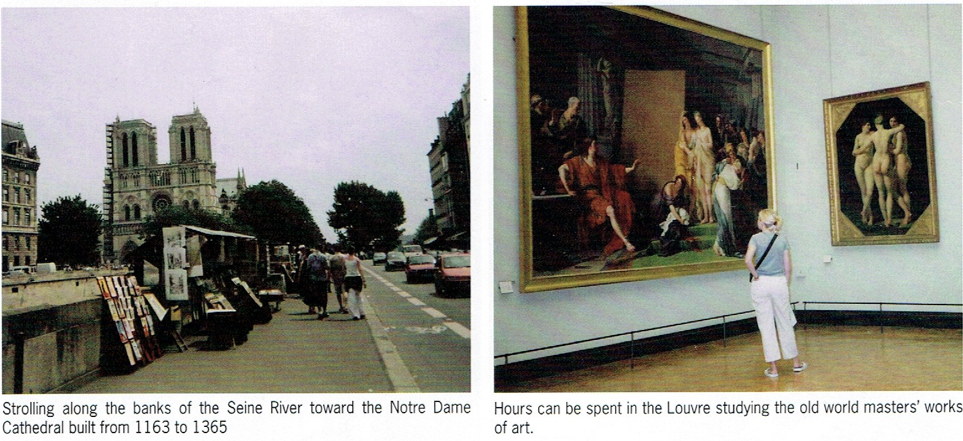
city and the Metro. Walking along the
banks of the Seine River to the Notre Dame
Cathedral (built from 1163 to 1365), we
were enticed to climb the 387 steps for an
unforgettable view.
One morning, while walking though
the park towards the Champs-Elysees and
the Arc de Triomphe, we encountered the
inaugural press coverage for Train Capitale,
a major exhibition of 30 French trains. Being
on the Champs-Elysees when it was closed to motor vehicles was a
unique experience. It was somewhat like being on Wall Street on a
Sunday.
A walk in the courtyard of the Conciergerie, where Queen Marie-
Antoinette and the other imprisoned royalty spent their final days, was
quite something. Les Miserables for real! The stark accommodations
were a dramatic contrast to the luxurious surroundings to which they
were accustomed.

The Sacre-Coeur, which sits high on the hill in Montmatre,
affords all visitors an appreciation for Romanesque and Byzantine
architecture beautifully intertwined in one monumental structure.
The Rodin Museum and gardens, filled with strong overpowering
figures sculpted by a genius, is a must, as is Invalides - Napoleon's
Tomb, designed by Liberal Bruand in the baroque style during the
1670s at the behest of King Louis XIV, originally as a place for the
wounded and invalid soldiers.
At the Eiffel Tower, built by Gustav Eiffel in 1889 for the World
Exhibition and centennial of the French Revolution, we enjoyed
breathtaking views from atop this famous 7,000-ton symbol of Paris.
What a pleasure to be able to spot the main attractions, most of
which we had visited.
After a walk through the Tuileries Gardens, we spent time at
the Louvre with a few great women: Mona Lisa and Venus de Milo
and the Three Graces. A stop at the Pompidou Center and a visit
to the neighborhoods of Les Halles market, St. Germaine, and the
Sorbonne made for another delightful day in Paris. In doing so, we
got a sense of the daily rhythm of the city
from the Parisienne's perspective.
The Opera Garnier is Paris's first and
grandest opera house, as evidenced by its
marble décor and magnificent chandeliers;
another architectural marvel. The Pantheon,
designed by Germain Soufflot over the
course of several years (1764 to1790), was
originally commissioned by Louis XV as
a church. Now a monument to France's
historic figures - including Voltaire, Zola and
Rousseau - it houses a giant 220-foot steel
pendulum commemorating Jean-Bernard-
Leon Foucault's 1851 experiment to prove
the earth's rotation.
A climb to the top of the Arc de
Triomphe, which stands 164 feet high and
was completed in 1836 to commemorate
Napoleon's victory at Austerlitz, enabled us
to see how 12 boulevards converge in one
gigantic traffic circle.
We took the Metro to Le Cordon Bleu,
the internationally acclaimed 100-year-old
cooking school, and then headed for the
Palace of Versailles (Château de Versailles).
It was a beautiful day to be visiting the Palace
and its surrounding gardens.
It was now time to head for five nights
in Amsterdam. At the train station we were
able to secure first-class seats on the Thayls
high-speed train. In less than three hours, we
were in Europe's most 17th-
century city filled with living
history, 800,000 inhabitants
and thousands of bicycles
- the favored means of
transportation. At the train
station we purchased some
tram tickets and headed for
the hotel.
With an Amsterdam
transit pass and museum
card in hand, we were set.
While at Dam Square, we
visited the Madame Tussaud
Museum where we saw the
likes of movie stars and
world leaders; even Elvis was
there. By stark contrast, we
later visited the Anne Frank
House, where Anne Frank
and her family hid during
the Nazi occupation of the
Netherlands during WWII.
They were just one of the
many families who were
secretly sheltered during this
horrific period in history. The
video interviews of Otto Frank
and his colleagues, which
was part of the presentation,
moved us to tears.

While taking a wonderfully relaxing
canal ride through the city, I was surprised
to learn that Amsterdam has more canals
than Venice. From the boat, we admired
the architectural design of the homes built
in the 1600s, all equipped with a clever
pulley system to hoist furniture through the
windows.

Our visit to the Van Gogh Museum
that featured 200 of his works was another
highlight of our stay. Stedelijk Museum,
which focuses on modern art, was less

thrilling. We walked about the very crowded
Leidseplein filled with outdoor cafés, and
took the bus to Volendam, a fishing village
and popular vacation spot.
After a visit to the Rijksmuseum,
where we were able to see masterpieces by
Rembrandt and other Dutch Masters, we
visited the Rembrandt House and saw the
living quarters of this "master," including
his bed and studio where he entertained
potential art dealers and patrons.
The ever popular Heineken tour enabled visitors to experience
the inner working of a brewery as well as enjoy the results of the
process. Needless to say, a good time was had by all.

A local bus took us to Molen van Sloten, the only working
windmill constructed to provide electricity for the municipality and,
at the same time, provide living accommodations for the family of
the worker taking care of it.
Later, we visited De Oulde Kerk for an exhibition of Impressionist
painting and De Nieuwe Kerk for an international press photo
exhibit.
At the Amsterdam House - a typical house of the 1600s, which
included a chapel with an impressive organ - we noted that climbing
those steep narrow staircases certainly kept the Dutch in shape.
Shortly after arriving in Cologne, Germany, (a three hour train
ride) we headed for the Cathedral with its magnificent stained-glass
windows and tapestries. The Dom, as it is known, was completed in

1880 and is one of the most massive Gothic structures ever built. The
spires, at 157 meters (510 feet), are quite the steep climb, but the
view from the top is breathtaking. A bus ride showing us the rebuilt
areas around the city made us realize how much of the city had
been destroyed during WWII. Interestingly enough, the Cathedral
remained unharmed.

While planning this portion of the trip, I discovered a town
named Boppard. Once there, we enjoyed a hotel room with balcony
and spectacular view of the Rhine River Valley. As we sailed along
the Rhine, we made a few stops: St. Goar for the fabled Lorelei, an

outcrop of rock where a maiden was said to have sat combing her
long blonde hair while luring passing sailors to watery graves and St.
Gorhausen for a visit to the Rheinfels Castle built in 1245 by Count
Dieter von Katzenelnbogen. Our final destination was the charming
town of Rudesheim with its many beer and wine gardens. On the
return trip to Boppard, we stopped at Bacharach for a few hours.
With the landscape dotted by vineyards and castles, the ride on the
Rhine was magnificent from start to finish.
Our journey was coming to an end, and so we boarded the train
for Brussels via Cologne. Spending the night in Brussels, which is less
than a two-hour train ride to Paris Charles de Gaulle Airport, enabled
us to immerse ourselves in the city famous as the center of culture
during the Middle Ages. Using the Internet, we found a fabulous
rate at the Royal Windsor Hotel, a five-star property ranked as one
of the best hotels in world. It was conveniently located in the heart
of the city and a few blocks from the Brussels Midi station. At La
Grand Place, the main square, we enjoyed the scenery as we shopped

for lace, Godiva chocolate and watercolor paintings; visited the City
Museum to see the many outfits for the famous Manneken Pis statue;
and ate our first Belgian waffle. The hop-on-hop-off bus provided us
with an open-air tour of Brussels, including: the headquarters of the
European Union EU, of which Belgium is the Capitol; the Atomium,
a giant molecule (symbol of the 1958 World's Fair exhibition); as well
as the Royal Palace and Gardens.
Lasting impressions: Western Europe is very internationalized,
as evidenced by the abundant supply of ethnic restaurants, Internet
cafes and ATMs. With living history at every turn, great museums,
great architecture, no border checks thanks to the EU, great public
transportation systems and tourist-friendly locals, you have all the
makings for a great trip.
My bags are packed for the next trip!


Comments